Introduction: The Importance of Discursive Essays in Education
As you embark on your college journey or work on enhancing your academic writing skills, you may have encountered the term discursive essay. However, you might still be unclear about its meaning or how it contributes to your writing development.
Discursive essays are among the most frequently assigned forms of writing in educational settings, especially within the social sciences and humanities, as well as in subjects involving debate. These essays assist you in honing your ability to critically assess issues, weigh evidence, and engage in logical thought by allowing you to argue both for and against a specific subject.
Unlike persuasive or argumentative essays that often present a singular viewpoint, discursive essays promote balance. Like other essay forms, discursive writing cultivates the essential skill of reconciling conflicting arguments, which proves invaluable not only in writing but also in making decisions.
What Is a Discursive Essay?
Now that we’ve established the basics, what exactly constitutes a discursive essay?
A discursive essay is a type of academic writing that evaluates a topic from various angles. Instead of advocating for a personal viewpoint or attempting to “win” an argument, the intention is to investigate several perspectives in an impartial and neutral manner.
When discussing issues such as social media, climate change, or online education, a discursive essay allows you to:
Also Read

- Clearly introduce a subject
- Present arguments on both sides
- Back each argument with logical reasoning and evidence
- Address opposing viewpoints respectfully
- Reach a balanced conclusion
Ultimately, a discursive essay demonstrates to the reader that you have engaged in thorough and critical contemplation of a topic, even if you share your own opinion at the conclusion.
Different Forms of Discursive Essays
Discursive essays can take on various forms. Depending on the subject matter and assignment specifics, your essay may fall under one of these categories:
Opinion-Based Discursive Essay
This style includes your viewpoint while still examining both aspects of the issue. You clarify your position after providing a balanced overview of opposing viewpoints.
For and Against Essay
In this format, you discuss the advantages and disadvantages of a topic equally, without favoring one side. This represents the most impartial and well-rounded type of discursive essay.
Solution-Oriented Essay
In this case, you identify a problem and analyze different solutions—again, from multiple viewpoints. These essays are frequently employed in the realms of public policy or social science.
Grasping the specific type of discursive essay you are writing will aid you in organizing your content more successfully and maintaining focus.
Writing a Discursive Essay: A Step-by-Step Approach
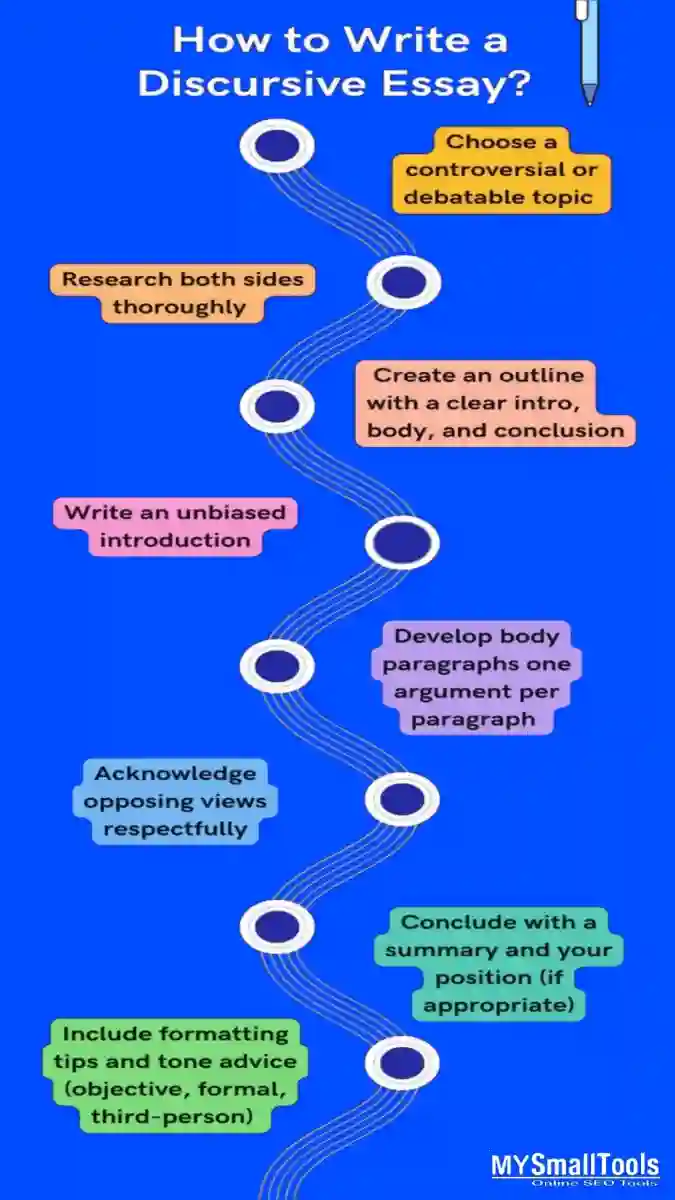
Are you prepared to begin writing? Adhere to these steps to create a coherent, engaging, and systematically arranged discursive essay.
Step 1: Select a Controversial Topic
Choose a subject that presents various viewpoints. It should be broad enough to allow for discussion but precise enough to keep your focus. For example, inquiring whether social media is harmful to young people? ” is preferable to simply stating “Social Media. ”
Step 2: Investigate All Perspectives in Depth
Avoid merely seeking information that aligns with your viewpoint. Look for evidence from a range of perspectives. This will help you maintain balance and enhance your credibility.
Step 3: Formulate a Detailed Outline
Outline your introduction, main body sections, and conclusion. Each section should concentrate on a single main idea and connect logically to the following one.
If you find it challenging to craft a robust outline or formulate your points, seeking academic assistance to compose your essay can offer useful guidance and structure to facilitate your writing efforts.
Step 4: Compose a Neutral Introduction
Begin by presenting the subject and its significance. Refrain from expressing your personal opinion at the outset.
Step 5: Construct Arguments Backed by Evidence
Devote one paragraph to each argument. Reinforce every argument with data, statistics, or real-life examples. Uphold an academic style.
Step 6: Consider Alternative Perspectives
Recognize the viewpoints of the opposing side. It is acceptable to disagree respectfully, but you must provide an explanation supported by evidence.
Step 7: End with a Well-Rounded Summary
Conclude the discourse and, if applicable, share your viewpoint—ensuring it reflects the arguments made earlier.
Tone Tip: Always utilize third-person narration, maintain formal language, and steer clear of emotionally charged or biased remarks.
Discursive Essay Structure Template
- Introduction
- Background on the topic
- Significance of the matter
- Thesis statement (maintaining a neutral or balanced perspective)
- Body Paragraph 1
- Supportive argument for side A + corroborating evidence
- Body Paragraph 2
- Supportive argument for side B + corroborating evidence
- Body Paragraph 3
- Opposing viewpoint or counterargument + refutation
- Conclusion
- Recap of main points
- Optional personal viewpoint
Need assistance rephrasing your research? Utilize MySmallTools’s Paraphrasing Tool to maintain the uniqueness of your writing.
Examples of Discursive Essays for Students
Below are two simplified examples to illustrate how a discursive essay is structured:
Example 1: Should Social Media Have Regulations in Educational Settings?
Introduction:
Social media is extensively integrated into the lives of students, yet its role in educational institutions has raised issues concerning distractions and mental well-being.
Argument 1 (Supporting Regulation):
Overuse may adversely affect students’ academic success and lead to increased stress.
Argument 2 (Supporting Regulation):
Restricting access could help diminish cyberbullying and peer pressure in educational settings.
Counterargument:
Some people believe social media serves as a platform for collaboration and personal expression. Its prohibition could hinder digital literacy.
Conclusion:
Despite the advantages of social media, regulating its use in schools could better safeguard students’ mental health and concentration.
Example 2: Is Working Remotely More Productive?
Introduction:
The rise of remote work worldwide has prompted discussions regarding its effects on productivity in the long run.
Argument 1 (In Favor):
Individuals working remotely experience greater job satisfaction and are less distracted.
Argument 2 (In Favor):
Businesses can reduce expenses on infrastructure and provide more adaptable work schedules.
Counterargument:
Detractors maintain that teamwork and relationship building suffer, which can detract from creativity and productivity.
Conclusion:
Remote work appears to boost productivity for many; however, a blended approach might yield the advantages of both arrangements.
Before you finalize your essay, check for originality using MySmallTools’s Plagiarism Checker.
Common Mistakes to Avoid in a Discursive Essay
Even essays that are thoroughly researched can miss the mark if you commit these frequent errors:
- Taking a definitive stance prematurely
- Leveraging emotional appeals
- Overlooking opposing viewpoints
- Neglecting to provide source citations
- Employing casual language or partial phrases
- Using copied material without rephrasing
Utilize MySmallTools’s Citation Generator to make certain that all your citations are accurately referenced and formatted.
Final Suggestions and Summary
Let’s briefly review:
- Maintain impartiality and refrain from bias
- Organize your essay clearly
- Provide evidence for every assertion
- Don’t omit counterarguments
- Check for grammatical errors and authenticity
Crafting a discursive essay requires practice, yet it is an essential skill that enhances your analytical thinking.
Want to ensure your discursive essay is distinctive and refined? Use MySmalltools’s Plagiarism Checker before submission.
Frequently Asked Questions
Q1. What sets a discursive essay apart from an argumentative essay?
Discursive essays seek to analyze both perspectives without advocating a strong viewpoint, while argumentative essays support a particular position.
Q2. Is it acceptable to express personal viewpoints in a discursive essay?
Yes, but this should be reserved for the conclusion and must be supported by evidence.
Q3. Should I incorporate references in a discursive essay?
Definitely. Citations are crucial for substantiating your arguments and preventing plagiarism.
Q4. What is the expected length of an essay for college?
Generally between 1000 and 1500 words, but verify with your instructor or assignment guidelines.
Q.5 Can AI be utilized to help in composing an essay?
You may use tools such as paraphrasers or grammar checkers, but always ensure that the content is original and properly cited.
